
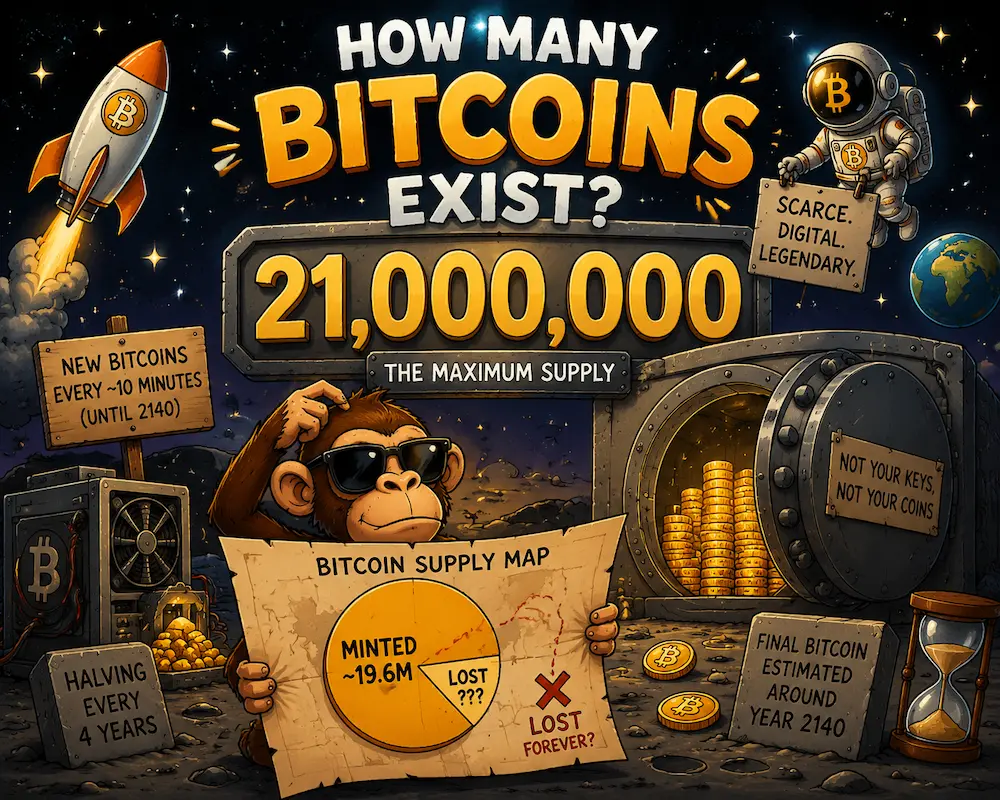
The Great Bitcoin Headcount Nobody Can Escape
At some point in every crypto journey, a very serious question appears — usually right after someone forgets their wallet password for the third time: how many Bitcoins actually exist?
The answer sounds simple, but like most things in crypto, it comes with a mix of mathematics, philosophy, and mild emotional damage.
Bitcoin is designed with a fixed supply of 21 million coins. That’s it. No secret printer, no emergency “add more coins” button hidden in the blockchain basement. Just 21 million, forever. Or at least until the heat death of the universe — whichever comes first.
The 21 Million Rule (a.k.a. “No, You Can’t Have More”)
Satoshi Nakamoto didn’t just create Bitcoin; they also created digital scarcity with the enthusiasm of someone locking cookies in a jar and swallowing the key.
Why 21 million? The honest answer is: because math meets economics, and also because 21 million sounds like a number that could plausibly win a lottery or confuse a banker.
New Bitcoins are released through mining, but every four years something called the “halving” occurs. This reduces the reward for miners, slowing down the creation of new coins like a built-in cosmic brakes system.
So yes — Bitcoin is basically the only asset where inflation is fighting with a scheduled appointment.
So… Do All 21 Million Actually Exist?
Not quite. And here comes the twist that makes crypto Twitter both laugh and cry.
A significant portion of Bitcoins are believed to be lost forever. Forgotten passwords, discarded hard drives, or that one guy who threw away a laptop thinking it was “just old gaming stuff” — all contribute to the legendary “lost BTC vault.”
Some estimates suggest that millions of Bitcoins may already be gone. Permanently. Like socks in a washing machine, but worth significantly more.
Why This Makes Bitcoin Weirdly Dramatic
Imagine a gold mine where gold keeps disappearing into alternate dimensions every year. That’s Bitcoin.
The supply cap creates a psychological effect: the closer we get to 21 million, the more people start acting like digital pirates guarding invisible treasure.
And yes, technically the last Bitcoin won’t be mined until around the year 2140. So if you’re reading this and planning to “buy the dip forever,” congratulations — you’ve got time.
Can Bitcoin Ever Change the Limit?
In theory, the community could try to change the rules. In practice, that’s about as likely as convincing cats to start a union.
The 21 million limit is deeply embedded in Bitcoin’s identity. Changing it would require global agreement, trust, and possibly a small miracle involving developers, miners, and internet debates surviving longer than 10 minutes without chaos.
So the short answer: no. The 21 million cap is about as flexible as a steel vault.
Final Thoughts: Scarcity with Internet Drama
So how many Bitcoins exist? Officially: 21 million. Realistically: a bit less, thanks to lost wallets and human optimism.
Bitcoin’s magic isn’t just in being digital money — it’s in being digitally limited. In a world where everything can be duplicated, Bitcoin decided to be stubbornly rare.
And that’s why every time someone asks “how many Bitcoins exist,” the real answer is not just a number — it’s a story about scarcity, memory, and the strange things humans forget in their drawers.
Or in crypto terms:
“Not your keys, not your coins… and sometimes, not your coins even if you had the keys.”