
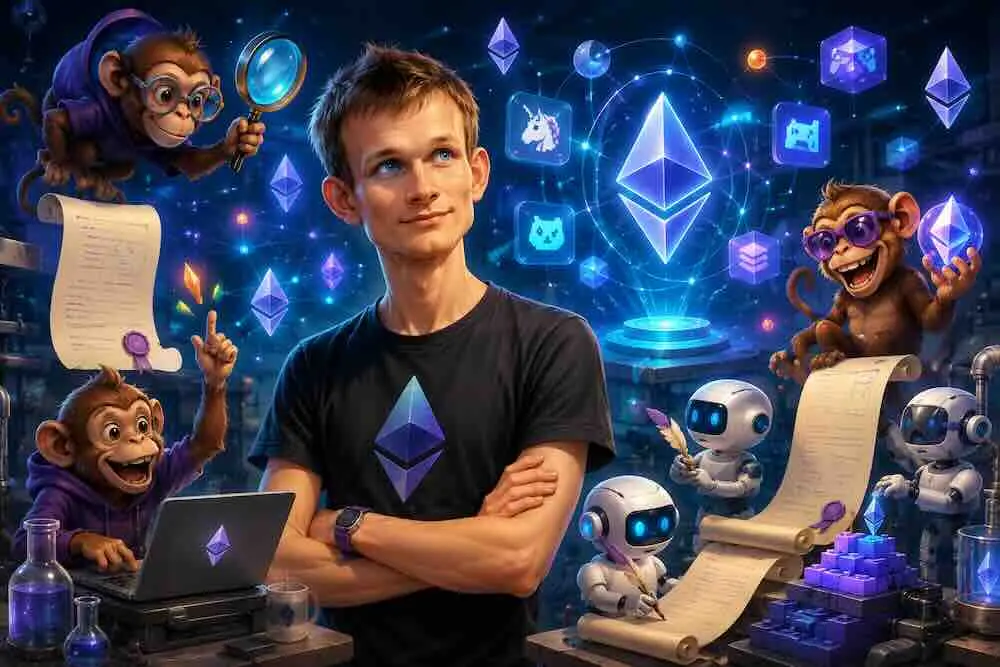
Some people wake up and decide to learn guitar. Some start jogging. Some buy a suspiciously expensive coffee machine and call it “self-care.”
And then there is the Ethereum founder, who looked at Bitcoin and thought, “Nice digital money. But what if the blockchain could also run tiny robot lawyers, unstoppable apps, digital cats, and financial experiments that make accountants blink twice?”
That person is Vitalik Buterin, widely known as the ethereum creator. And whether you see Ethereum as a world computer, a crypto playground, or a place where gas fees once made people question their life choices, one thing is clear: the story is anything but boring.
Before Ethereum, Crypto Was Mostly About Money
In the early crypto days, Bitcoin was the main character. It was dramatic, mysterious, and had the energy of a digital gold bar wearing sunglasses.
Bitcoin proved that money could exist without a bank politely standing in the middle and charging a fee for breathing. But Vitalik saw another possibility. He imagined a blockchain that could do more than move coins from one wallet to another.
He wanted programmable money. Programmable agreements. Programmable everything.
Basically, while others were asking, “Can we send value online?” the Ethereum founder was asking, “Can we build an entire digital civilization where code handles the boring paperwork?”
That is both genius and the kind of idea that makes family dinners complicated.
The Big Ethereum Idea
Ethereum introduced smart contracts. Despite the name, smart contracts are not contracts wearing glasses. They are pieces of code that automatically execute when certain conditions are met.
For example, instead of trusting someone to send funds after a deal, a smart contract can handle it automatically. No awkward reminders. No “I’ll send it tomorrow.” No cousin named Kevin mysteriously disappearing after borrowing crypto.
This opened the door to decentralized apps, tokens, NFTs, DeFi, DAOs, and many other acronyms that make crypto beginners feel like they accidentally walked into a software engineering exam.
The ethereum creator did not just launch another coin. He helped launch an ecosystem.
Why Vitalik Became a Crypto Icon
Vitalik Buterin does not look like the typical tech billionaire stereotype. There is no villain chair, no golden yacht energy, no “I bought the moon and renamed it BetaTest-7” vibe.
Instead, he became famous for being thoughtful, technical, oddly calm, and deeply involved in Ethereum’s future. In a market where some projects sound like they were named by a blender full of buzzwords, Vitalik became a rare figure people actually listen to.
He writes. He debates. He explains complicated ideas. He appears at conferences where half the audience understands every word and the other half nods with spiritual confidence.
And somehow, he became one of the most recognizable people in crypto without acting like a walking energy drink commercial.
Ethereum’s Wild Digital Zoo
Once Ethereum arrived, crypto changed from “digital money” into a full carnival of experiments.
Suddenly, people could launch tokens. Communities could build decentralized organizations. Artists could sell NFTs. Developers could create apps that run without traditional middlemen. Finance could be rebuilt on-chain, sometimes beautifully, sometimes like a toaster trying to become a bank.
Ethereum became the home of innovation, chaos, memes, and projects with names that sound like rejected breakfast cereals.
This is part of its charm. Ethereum is not just one thing. It is a platform where serious infrastructure and absolute internet weirdness live in the same apartment.
The Gas Fee Comedy Show
Of course, no Ethereum story is complete without mentioning gas fees.
Gas fees are payments users make to process transactions on the network. In calm periods, they can be manageable. During hype moments, they can feel like paying a luxury tax for clicking a button.
At times, users joked that buying a small NFT required one wallet, two prayers, and the emotional strength of a mountain goat.
But this also showed Ethereum’s popularity. People were using it so much that the network became crowded. In crypto terms, this is both a problem and a compliment. Like a restaurant being so popular that customers start eating in the parking lot.
The Merge and Ethereum’s Evolution
Ethereum did not stay frozen in its original form. One of its biggest milestones was The Merge, when Ethereum moved from proof-of-work to proof-of-stake.
For normal humans, that sounds like a wizard changing the engine of a flying castle while everyone is still inside.
In simple terms, Ethereum changed how the network is secured and how new blocks are validated. It was a major technical upgrade and one of the most watched events in crypto history.
The ethereum creator and the broader Ethereum community have always treated the project as something that evolves. Ethereum is not a finished statue. It is more like a software organism that keeps learning new tricks.
Why the Ethereum Founder Still Matters
Many crypto projects depend on hype. Ethereum depends on builders. That is one reason Vitalik’s role remains important. He is not just a founder from the past; he is still part of the conversation about scalability, privacy, decentralization, and what blockchain should become.
His influence comes from ideas more than marketing. In a noisy industry, that matters.
The Ethereum founder helped turn blockchain from a payment concept into a platform for digital ownership, decentralized finance, and programmable applications. Whether you love Ethereum, complain about it, trade it, build on it, or simply watch from a safe distance with popcorn, its impact is hard to ignore.
Final Thoughts
The story of the Ethereum founder is not just about one person creating a crypto project. It is about one idea becoming a giant ecosystem.
Vitalik Buterin saw blockchain as more than digital cash. He saw it as a foundation for applications, communities, and contracts that could operate without traditional gatekeepers.
And yes, the journey included confusing acronyms, expensive gas fees, monkey JPEGs, and enough crypto drama to power several reality shows.
But that is exactly why Ethereum remains fascinating.
The ethereum creator did not just give crypto another coin. He gave it a playground, a laboratory, and occasionally, a very expensive button to press.