
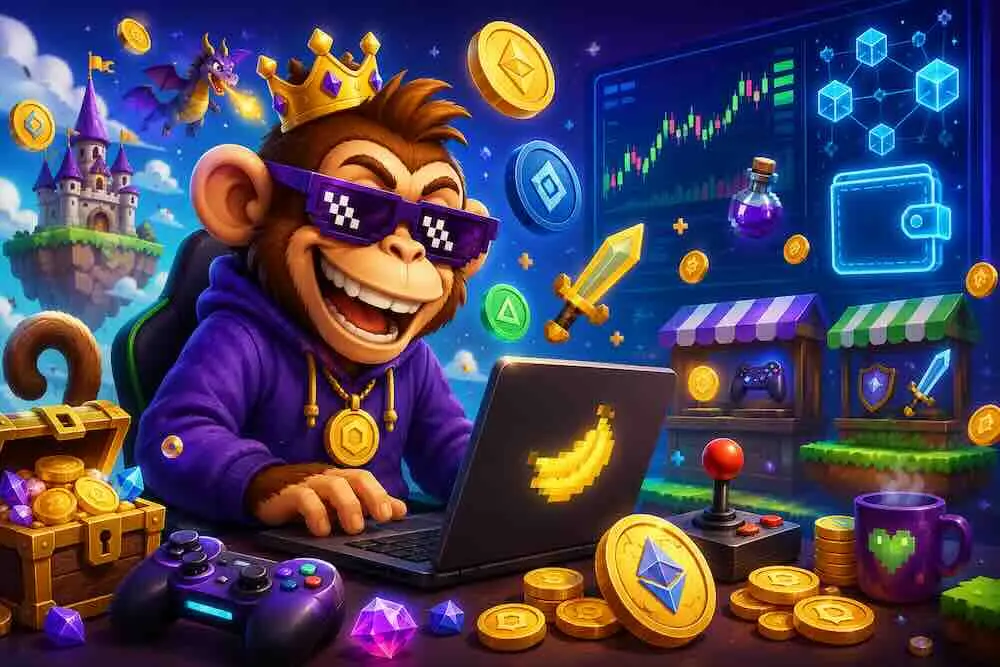
Crypto games are what happens when video games, digital wallets, and financial curiosity walk into the same room and all pretend they know what blockchain is.
Once upon a time, games were simple. You bought a disc, inserted it into a console, and spent six hours trying to defeat a boss who looked like an angry refrigerator. Today, you can play a game, collect digital items, trade tokens, use crypto currency, and explain to your confused friend why your cartoon sword is “technically an asset.”
Welcome to crypto games — the part of the internet where fun, finance, and mild panic hold hands.
What Are Crypto Games?
Crypto games are online games that use blockchain technology, tokens, NFTs, or other digital assets inside the gameplay. In normal games, your items usually stay locked inside the game. In crypto games, some items may be stored on a blockchain, traded between users, or connected to a digital wallet.
In simple words: your game character may own something that exists outside the game too.
That sounds futuristic, but also a little funny. Imagine telling your grandmother:
“Grandma, I cannot come for dinner. My digital monkey needs me to manage his token economy.”
She may not understand. But she will probably respect the monkey.
Why Do People Play Crypto Games?
People play crypto games for different reasons. Some like the gameplay. Some enjoy collecting digital items. Some are curious about blockchain. And some just saw a futuristic-looking trailer and thought, “Yes, I too want to ride a cyber dragon through a market crash.”
The main appeal is ownership. In many crypto games, players may have more control over in-game items. A weapon, skin, card, land plot, or character can sometimes be traded or transferred.
That does not mean every item will become valuable. Sometimes your rare digital helmet is worth something. Sometimes it is just a helmet with attitude.
Crypto Currency Enters the Game
Crypto currency is often used inside these games for payments, rewards, upgrades, or marketplace activity. Instead of using only traditional in-game coins like “gold,” “gems,” or “magic beans,” crypto games may use tokens connected to blockchain networks.
This makes the experience feel more open, but also more complicated.
In a regular game, you ask:
“Do I have enough coins for this sword?”
In a crypto game, you ask:
“Do I have enough tokens, is my wallet connected, what is the network fee, and why does this fox logo keep staring at me?”
The learning curve can be real. But for many players, that is part of the adventure.
The Role of a Crypto Exchange
A crypto exchange can be part of the journey when players need to buy, sell, or swap digital assets. It acts like a marketplace where users can trade one crypto currency for another.
For example, a player may need a specific token to enter a game, buy an item, or participate in the game economy. That token might be available through a crypto exchange.
Of course, this is where the “game” starts feeling like a side quest in personal finance. You wanted to play with dragons, and now you are checking charts like a very nervous accountant.
Still, understanding how exchanges work can help players move more confidently in the crypto gaming world.
Are Crypto Games Only About Money?
No. At least, they should not be.
The best crypto games need to be enjoyable first. If a game is boring, no amount of blockchain sparkle can save it. A dull game with tokens is still a dull game. It is just dull in a more complicated way.
Good crypto games combine fun mechanics with useful digital ownership. The crypto part should support the experience, not replace it.
Because let’s be honest: nobody wants to play “Spreadsheet Warrior 3000” unless the boss fight is against tax season.
The Funny Side of Crypto Games
Crypto games create situations traditional gaming never prepared us for.
You may lose a match and think, “Fine, I need more practice.”
You may also lose a match and think, “Fine, I need to understand liquidity.”
That is a very different emotional journey.
There is also the language. Crypto gaming communities love phrases like “tokenomics,” “staking,” “minting,” and “on-chain assets.” It sounds less like gaming and more like a wizard school for finance students.
But that is part of the charm. Crypto games are still young, experimental, weird, and sometimes surprisingly creative. They attract players who like technology, digital culture, and the idea that a game item can be more than just pixels trapped in one platform.
What Should New Players Remember?
New players should approach crypto games with curiosity, but also common sense. Not every game is worth your time. Not every token will grow. Not every digital chicken needs to be purchased immediately.
Before joining a crypto game, check how it works, what wallet it requires, whether the gameplay is actually fun, and how the in-game economy functions. Read community feedback and avoid rushing into anything just because someone on the internet used too many rocket emojis.
Crypto games can be entertaining, but they are not magic money machines. They are games with digital economies — and sometimes those economies behave like cats on espresso.
Final Thoughts
Crypto games are one of the strangest and most interesting corners of the digital world. They mix gaming, blockchain, crypto currency, digital ownership, and marketplace culture into one chaotic playground.
For some players, they offer a new way to interact with games. For others, they are simply another reason to open a wallet, forget a password, and question modern life.
Either way, crypto games are here, they are evolving, and they are definitely not boring.
So grab your digital backpack, connect your wallet carefully, and remember: in crypto gaming, the final boss may not be a monster.
It may be the gas fee.